
Our infrastructure
Learn more about the critical infrastructure including substations, transmission lines and supporting systems that work together to deliver a safe, reliable electricity supply across Queensland's transmission network.
Our transmission network extends 1,700km from north of Cairns to the New South Wales border, and comprises 15,697 circuit kilometres of transmission lines and 156 substations.
What is a substation?
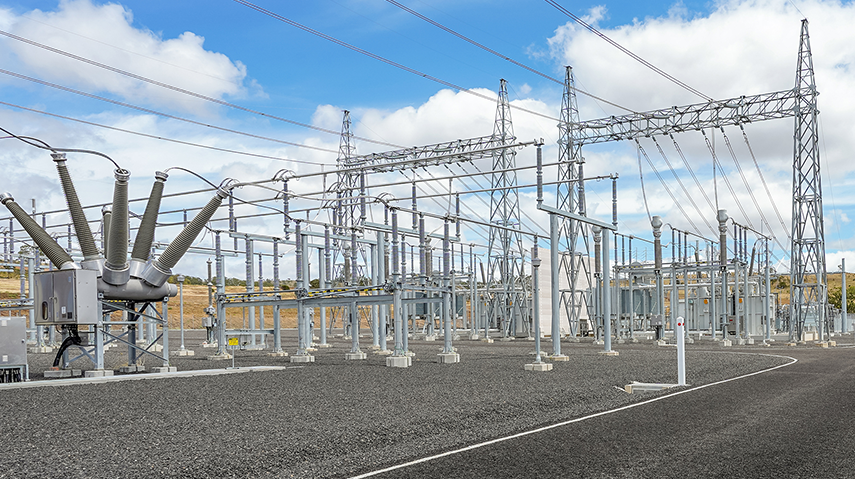
Substations manage the flow and voltage levels of electricity around the transmission network and help keep the network stable to provide a reliable electricity supply.
Electricity enters and leaves the substation via transmission lines – electricity is not generated at a substation. Generators or large industrial customers can link to the transmission network by connecting to a substation.
Powerlink’s substations typically convert electricity from high voltages to lower voltages so it can be delivered to the distribution networks operated by Energex and Ergon Energy for delivery to residential customers and businesses. Substations also convert electricity to higher voltages to be efficiently transported across large distances.
Substation equipment
A substation contains electrical equipment as well as buildings to house equipment for monitoring and control of the network. Equipment includes:
- transformers to convert electricity to a higher or lower voltage
- switches to interrupt the flow of electricity or disconnect parts of the substation for safe maintenance work
- instruments to measure the flow of electricity for metering and to protect equipment
- busbars to move electricity around the substation.
What is a transmission line?
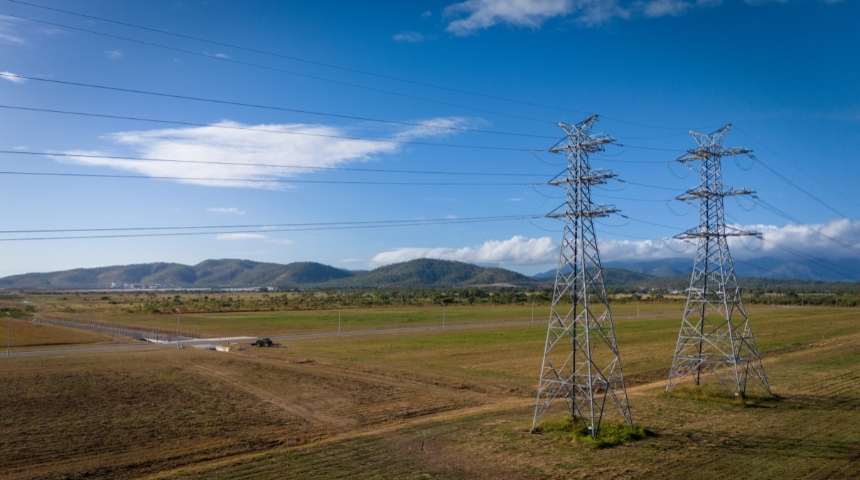
A transmission line is a powerline which is capable of carrying large amounts of electricity at high voltages. In Queensland, transmission lines generally carry electricity at 132 kilovolts, 275 kilovolts or 330 kilovolts (kV).
Transmission lines are larger and taller than the everyday distribution powerlines which deliver electricity to your home and business.
Transmission structures
Transmission lines are normally built on tall steel towers or concrete and steel poles.
The distance between structures, structure height, footprint and design vary to accommodate the number of conductors, voltage carried, and the local topography, land use and environment.
Powerlink uses a range of structures to maintain a safe electrical clearance between the conductors and the ground below. When topography is considered it directly influences the tower height i.e. either increasing or decreasing depending on network requirements for a specific area.
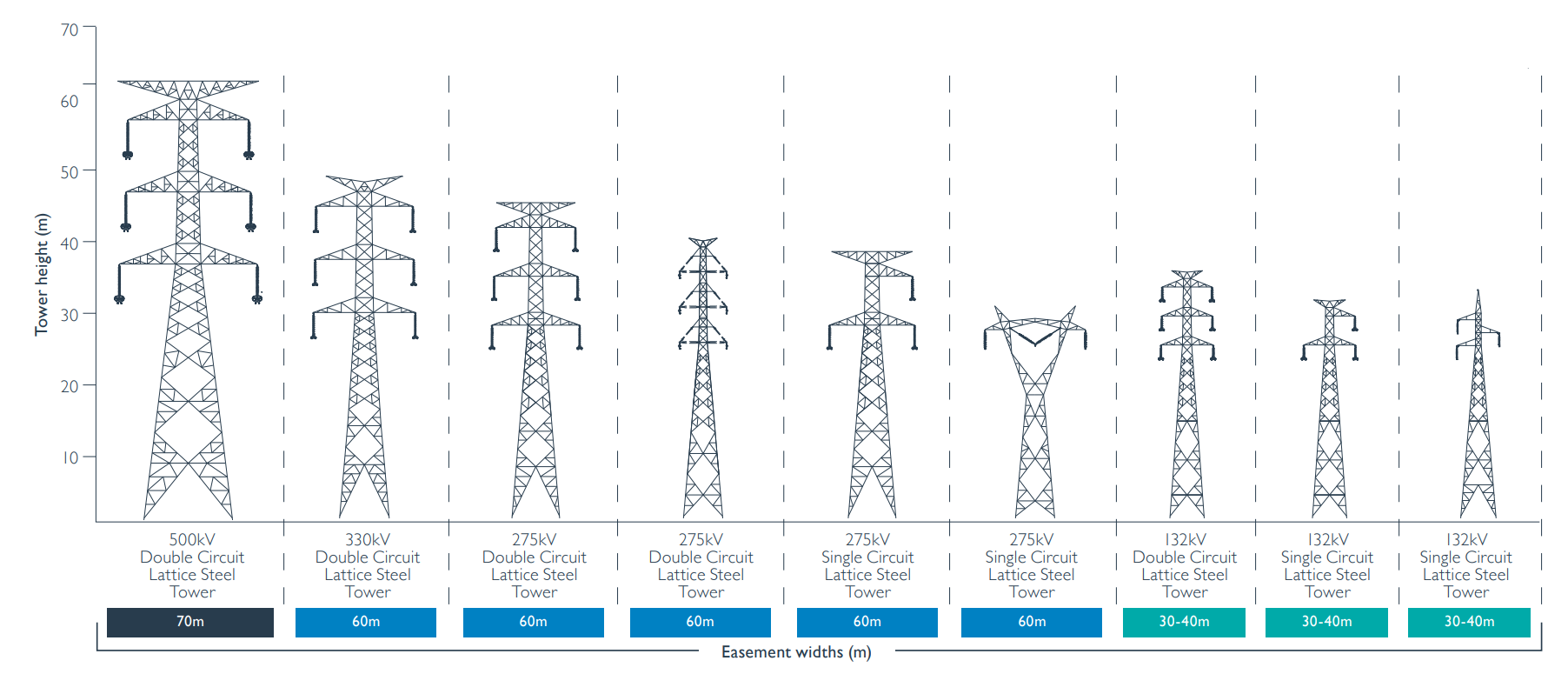
What are the componEnts of a typical Transmission tower?
- Earth wires: One or two earth wires are attached to the top of each structure to shield the conductors from direct lightning strikes. Some earth wires may contain optic fibre for communications purposes, enabling Powerlink to remotely monitor, control and protect the transmission network.
- Insulators: Strings of insulators support the conductors and create an insulated safe distance between the high voltage electricity and the structure. Insulators are generally made of porcelain, glass or polymer materials.
- Conductors: Conductors are the wires that carry electricity. They are made of aluminium alloy or steel-reinforced aluminium and are installed at a height to allow for safe electrical clearance between the conductor and the ground.
- Circuits: Powerlink’s transmission lines are either single or double circuit. A circuit consists of three electrical phases, where each phase is transmitted via a single conductor or a bundle of conductors. Conductors are spaced at a distance to maintain safe electrical spacing and avoid flashovers.
- Anti-climbing devices and signs: To ensure public safety, Powerlink installs warning signs and anti-climbing features as a physical barrier on all transmission structures.
- Foundations: A foundation is the mechanism that anchors the pole or tower leg into the ground. It is usually several metres deep to provide structural stability. The foundation type used is dependent on the soil properties. Individual foundations will support the four legs of a lattice type tower. In the case of a pole, a large single foundation is used. Guyed structures sit on one small central foundation and are typically supported by four guy wires, each with its own foundation.
What is a synchronous condenser?
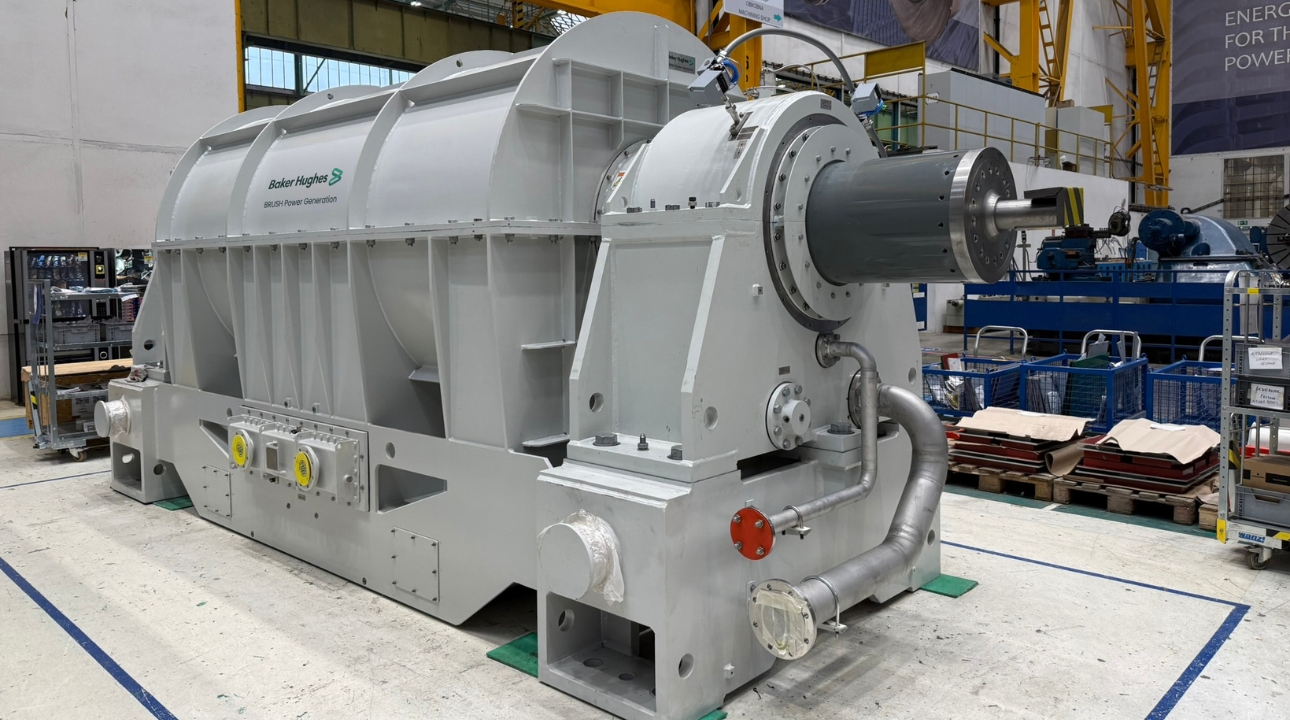
A synchronous condenser is a large rotating machine that acts like a shock absorber to smooth out fluctuations in the electricity grid to maintain system strength.
Synchronous condensers are typically installed at or near high voltage substations, and are connected by a short single-circuit 275kV transmission line.
A synchronous condenser is installed inside a shed alongside supporting infrastructure including transformers, a control room and cooling systems.
Learn more about our System Strength Project and synchronous condensers in Central Queensland: